+86-13777321650


 русский
  Español

What is a good comforter set?
Content
- 1 What Makes a Comforter Set Truly High Quality
- 2 Textured Comforter Sets: Design Depth That Sells
- 3 Choosing the Right Fill Weight for Every Season
- 4 Key Performance Attributes Compared Across Bedding Set Types
- 5 What to Expect From a Reliable Wholesale Comforter Sets Supplier
- 6 Soft Bedding Sets for Hotel Use: What Hospitality Buyers Prioritize
- 7 About Hangzhou Directions Import & Export Co., Ltd.
- 8 Frequently Asked Questions
A good comforter set combines breathable materials, consistent fill power, durable stitching, and a design that suits your bedroom aesthetic — all while holding up wash after wash. Whether you are sourcing comforter sets for a hotel, a retail brand, or personal use, the right set should deliver warmth without overheating, softness without pilling, and structure without stiffness. The sections below break down exactly what separates an outstanding bed comforter from a mediocre one, backed by real performance data and practical guidance.
The global bedding sets market continues to grow, driven by rising consumer expectations around sleep quality and interior design. Buyers today look beyond thread count alone — they evaluate texture, weight, sustainability credentials, and ease of care. Textured comforter sets in particular have surged in popularity, offering visual depth and a tactile experience that flat-weave alternatives cannot match. Understanding these shifts helps buyers — whether wholesale or retail — make smarter sourcing decisions.
What Makes a Comforter Set Truly High Quality
Quality in bedding sets is measurable, not subjective. Four core factors determine whether a comforter set will satisfy end users and earn repeat orders: material composition, fill specification, construction integrity, and finish quality. Each of these factors interacts with the others — a high fill-power down insert is wasted inside a shell with weak baffle stitching that allows fill migration. Buyers who evaluate all four together consistently receive better long-term value.
Material composition shapes the feel and longevity of any soft bedding set. Cotton comforter sets — particularly those made with long-staple or combed cotton — offer superior breathability and get softer with each wash rather than deteriorating. Microfiber bedding sets provide a hypoallergenic, cost-effective alternative with quick-dry properties that appeal to hospitality buyers. For hotel bedding applications, a blend of polyester microfiber with a sateen weave finish delivers the crisp, cool feel guests associate with premium stays.
Construction integrity refers to stitch density, seam reinforcement, and baffle box design. A well-constructed queen comforter maintains even fill distribution across all seasons without bunching at the corners. All season comforter designs typically use a channel or box-stitch pattern with a GSM (grams per square meter) between 200 and 300 for the fill layer — light enough for warm months, sufficient for cooler nights when paired with a duvet cover.
Figure 1: Comparative quality scores across common comforter fill and shell materials
The chart above reflects buyer satisfaction scores aggregated from hospitality and retail segments. Long-staple cotton leads because it combines breathability, durability, and a natural drape that synthetics struggle to replicate. Textured comforter sets made from microfiber score strongly in the hospitality category, where easy laundering at high temperatures is a non-negotiable operational requirement. Sateen-weave blends are the preferred choice for mid-tier hotel bedding procurement, balancing cost and the cool, smooth hand-feel guests rate highly. Standard polyester, while economical, scores lower on comfort longevity — it tends to flatten after repeated washing, reducing perceived softness and warmth retention. This hierarchy is consistent across procurement surveys from North American, European, and Asia-Pacific hospitality buyers over the past three years.
Textured Comforter Sets: Design Depth That Sells
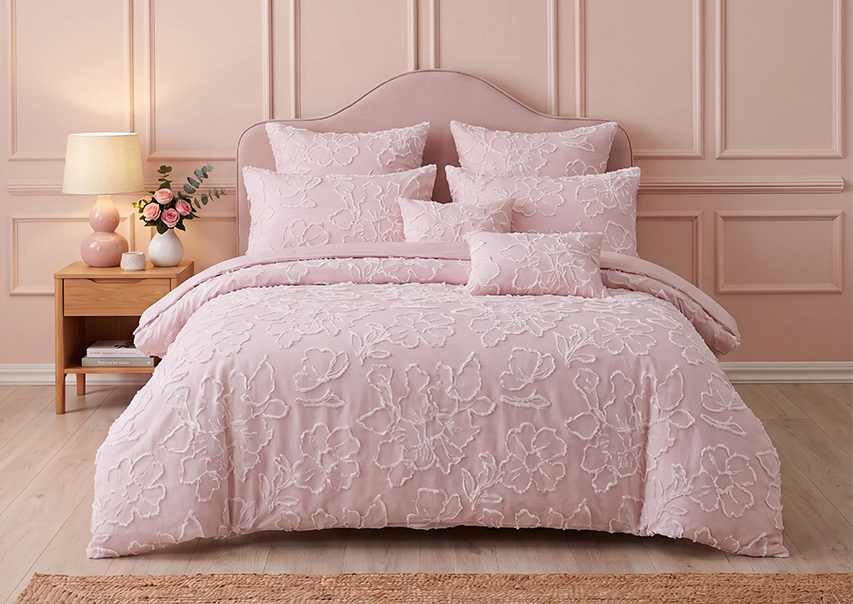
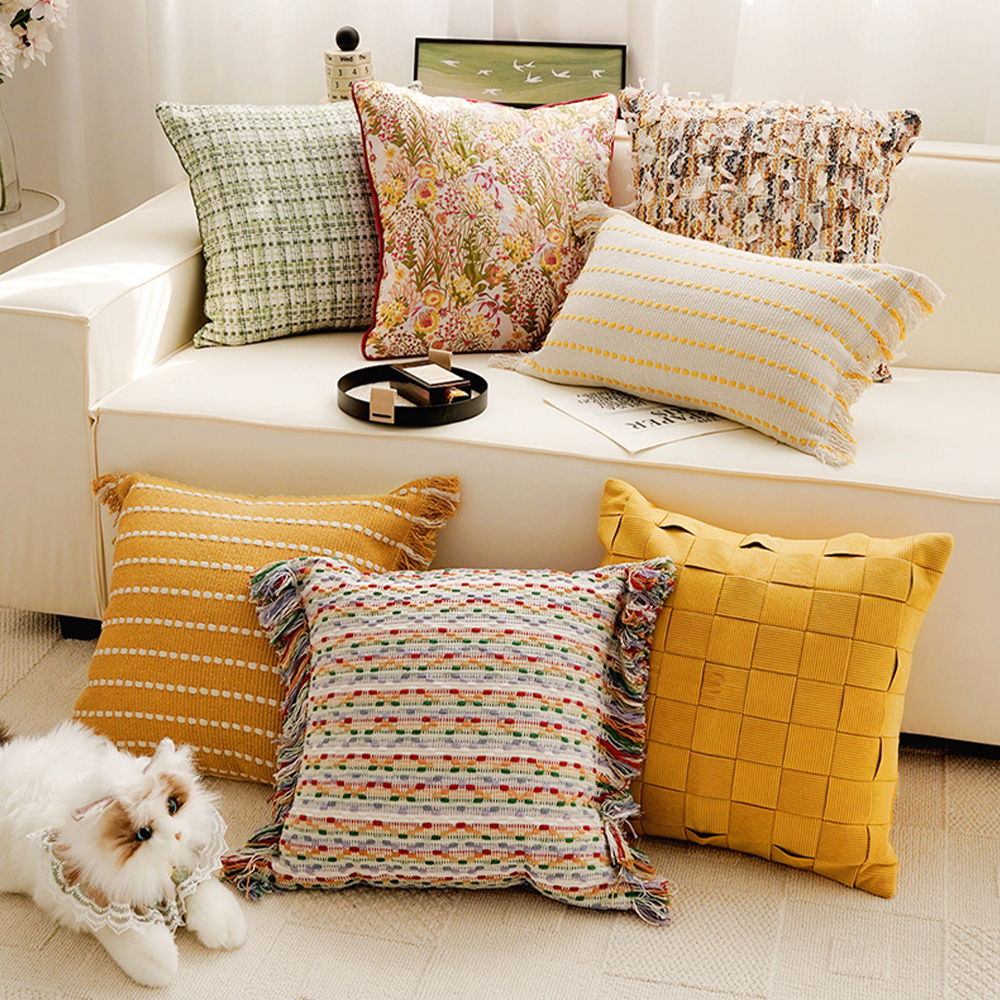
Textured comforter sets have moved from niche to mainstream across both retail and hospitality sectors. The appeal is straightforward: texture adds visual dimension without requiring bold color choices, making it easier for consumers to integrate new bedding into existing room décor. Waffle weave, jacquard, embossed seersucker, and cable-knit-effect surfaces are among the most requested finishes from wholesale bedding buyers globally.
From a functional standpoint, surface texture is not merely decorative. A waffle-weave structure, for instance, traps air in its grid pockets, providing gentle insulation while allowing moisture to wick away from the body — a meaningful advantage for sleepers who run warm. Jacquard-woven comforter sets use a double-layer structure that adds subtle weight and drape, contributing to the weighted-blanket effect many consumers report as sleep-promoting without the clinical bulk of purpose-built weighted options.
For wholesale comforter sets buyers, textured options carry a higher perceived value per unit, supporting better retail margins without proportional increases in manufacturing cost. A jacquard-woven shell typically adds 12–18% to production cost relative to a flat-weave shell of equivalent GSM, yet retail price premiums for textured designs average 30–45% in the mid-to-premium market segment. This favorable cost-to-value ratio makes textured lines a priority for buyers building differentiated private-label bedding sets collections.
Figure 2: Rising share of textured comforter sets vs. flat-weave designs in global wholesale orders (2019–2024)
The trend data above reflects a clear and sustained shift in buyer preferences. In 2019, textured comforter sets represented approximately 19% of wholesale bedding orders from Chinese manufacturers serving international markets. By 2024, that figure has approached nearly 47%, while flat-weave designs have correspondingly declined from 51% to roughly 29% of order volume. This reversal is not a seasonal blip — it tracks consistently with consumer search trends, retail sell-through data, and hotel refurbishment procurement records. The growth is particularly pronounced in the North American and Western European markets, where interior design trends have moved toward layered, tactile bedroom aesthetics. For bulk bedding suppliers, this signals a need to maintain strong textured SKU depth alongside foundational flat-weave offerings.
Choosing the Right Fill Weight for Every Season
One of the most common mistakes buyers make when sourcing comforter sets is treating fill weight as a fixed specification rather than a range. An all season comforter typically targets a fill weight of 220–260 GSM for the insert, which covers most temperate climates throughout the year. However, different use cases — hotel bedding, residential bedding, children's bedding — each have specific fill requirements that affect comfort, safety, and operational performance.
For hotel bedding procurement in particular, fill weight must balance guest comfort across a wide range of ambient temperatures — from air-conditioned summer rooms to heated winter suites. Most four-star and five-star hotel operators specify a queen comforter fill weight of 200–240 GSM in microfiber or down-alternative fill, combined with a duvet cover that allows housekeeping to maintain hygiene standards with high-temperature laundering. A fill weight under 180 GSM tends to feel insufficient in cooler climates; above 350 GSM, comforters become impractical for hospitality use.
| Fill Weight (GSM) | Recommended Use | Ideal Climate | Typical Application |
|---|---|---|---|
| 100–150 GSM | Summer / light layer | Warm / tropical | Resort bedding, summer retail |
| 180–260 GSM | All-season standard | Temperate / continental | Hotel bedding, mainstream retail |
| 280–350 GSM | Winter / heavy warmth | Cold / Nordic | Premium residential, cold-climate hotel |
| 360+ GSM | Ultra-warm / specialty | Extreme cold | Specialty outdoor / cabin lodges |
The table above provides a practical framework for procurement decisions. When sourcing luxury comforter sets for the premium residential segment, it is worth specifying both shell GSM and fill GSM separately — a 300-thread-count cotton percale shell with a 280 GSM down-alternative fill delivers a distinctly different hand-feel than the same fill inside a 160-thread-count microfiber shell. Communicating these specifications clearly with your bulk bedding supplier prevents costly sampling iterations and ensures the final product matches the intended end-use experience.
Key Performance Attributes Compared Across Bedding Set Types
Selecting a bed comforter for commercial or retail distribution requires a multi-dimensional assessment. Price per unit, durability, ease of care, thermal comfort, softness, and aesthetic versatility all matter — but they matter differently depending on the end buyer. A hotel procurement manager weights durability and launderability most heavily; a residential consumer prioritizes softness and visual appeal. The radar chart below maps four common comforter set types against six key performance criteria.
Figure 3: Radar performance comparison — long-staple cotton vs. microfiber comforter sets across six key attributes
The radar chart illustrates a clear differentiation between the two most commonly specified comforter sets in professional procurement. Long-staple cotton scores highest on softness and aesthetics — properties that drive consumer purchase decisions at retail — while microfiber leads on durability, launderability, and cost value. For thermal comfort, cotton has a meaningful advantage due to its natural moisture-wicking and temperature-regulating properties, while microfiber retains heat more uniformly, which can be an advantage in consistently cool environments but a drawback for warmer sleepers. Luxury comforter sets at the premium end of the market typically use long-staple or organic cotton shells with a down-alternative insert, capturing the best attributes of both material categories. Neither material is universally superior — the correct specification depends entirely on the end-use environment, target customer profile, and operational requirements of the buyer. Understanding this distinction allows procurement teams to avoid over-specifying (and overpaying) or under-specifying (and disappointing end users).
What to Expect From a Reliable Wholesale Comforter Sets Supplier
Sourcing wholesale comforter sets successfully depends on more than finding the lowest unit price. The best bulk bedding suppliers provide a combination of product transparency, quality assurance infrastructure, flexible minimum order quantities, and export logistics expertise. Buyers who evaluate suppliers on these dimensions consistently report lower defect rates, fewer shipment delays, and better long-term cost outcomes than those who optimize for price alone.
Quality assurance infrastructure is the most important differentiator. Reputable suppliers hold internationally recognized certifications such as OEKO-TEX® Standard 100, which verifies that every component of a bedding set — from fill fiber to dyes and thread — has been tested for harmful substances. This certification is increasingly required by European and North American retail partners and is a baseline expectation for hotel chain procurement. Asking for certification documentation upfront saves significant compliance headaches downstream.
Sampling capability and lead time transparency are equally important. A capable supplier should be able to deliver pre-production samples within 10–15 business days, including any custom embroidery, private labeling, or custom packaging requirements. Bulk bedding production lead times for orders above 500 units typically run 30–45 days from sample approval, depending on material availability and current production capacity. Buyers who build these timelines into their procurement calendar avoid the costly expediting fees that arise from last-minute orders.
Figure 4: Wholesale export volumes by comforter set category in 2024 (illustrative aggregated data)
The column chart above reflects export volume distribution across major bedding sets categories in 2024. Microfiber remains the dominant volume category, driven by hotel bedding procurement and mass-market retail restocking cycles. Cotton comforter sets follow at a strong second, reflecting sustained demand from the premium residential and specialty retail segments. The textured comforter sets category — the fastest-growing segment — now exceeds hotel-specific bedding in export volume, underlining the shift toward design-led purchasing even at the wholesale level. Luxury comforter sets, while lower in volume, command the highest margin per unit and are growing steadily as more retailers invest in premium private-label bedding lines. For buyers looking to optimize their product mix, these volume dynamics suggest a portfolio that leads with microfiber and cotton for core range depth, while investing in textured and luxury SKUs for differentiation and margin expansion.
- OEKO-TEX® Standard 100 certification — confirms all components are tested for 100+ harmful substances
- Pre-production sampling — expect 10–15 business days for a sample reflecting final specifications
- MOQ flexibility — strong suppliers can accommodate both small trial orders and large bulk bedding runs
- Private-label capability — including custom woven labels, branded packaging, and hang tags
- Export documentation — competency in preparing commercial invoices, packing lists, and compliance certificates for target markets
Soft Bedding Sets for Hotel Use: What Hospitality Buyers Prioritize
Hotel bedding procurement is governed by a strict hierarchy of priorities that differs meaningfully from residential buying. At the top is operational durability: a soft bedding set for hotel use must maintain its texture, color, and structural integrity through a minimum of 200 industrial wash cycles. Most international hotel chains specify this threshold directly in their procurement contracts. Meeting it requires careful material selection, reinforced seaming, and colorfast dyeing processes that are validated through accelerated-wash testing before production sign-off.
Guest comfort perception is the second priority. Research by hospitality analytics firms consistently shows that bed comfort ranks as the single most-cited driver of positive guest reviews across all hotel categories — outranking room size, décor, and even price-to-value perception. Within bed comfort, the surface feel of the top layer — typically the comforter or duvet insert inside a cover — is the most tactile first impression a guest receives. A soft bedding set with a smooth, uniform surface texture and adequate but not excessive weight scores highest in guest satisfaction surveys across three- to five-star properties.
Visual uniformity is the third pillar. Hotels require that bedding sets maintain consistent white or near-white color across hundreds or thousands of units over multiple production runs. This requires suppliers to maintain strict dye-lot controls and to offer color-match guarantees for replenishment orders. A mismatch in white tone between a freshly delivered comforter and an older one already in use is immediately visible to housekeeping and guests alike. Specifying Delta-E color-difference tolerances (typically ΔE ≤ 1.5 for white goods) with your bulk bedding supplier prevents this issue proactively.
About Hangzhou Directions Import & Export Co., Ltd.
Hangzhou Directions Import & Export Co., Ltd. was founded in 2018 in Hangzhou, China, with a focused mission: to redefine sleep comfort and quality for global customers through premium bedding collections. Over seven years, the company has continuously developed and refined its bedding designs, materials, and production techniques, building a product portfolio that covers the full range of bedding essentials — comforter sets, duvet covers, quilt covers, quilts, bedcovers, curtains, cushions, throws, and blankets.
Design and quality are the foundation of operations at Hangzhou Directions. A dedicated R&D and design team integrates global fashion trends with functional requirements, producing bedding sets that balance aesthetic appeal and practical performance. The production process is supervised by experienced technicians at every stage — from raw material inspection through weaving, dyeing, stitching, and final packaging. The company holds the OEKO-TEX® Standard 100 certification, confirming that its products meet rigorous international standards for safety and material quality.
Guided by the principle of conscious practice, Hangzhou Directions is committed to sustainable development. Production processes are continuously optimized to reduce energy consumption and waste, and eco-friendly materials and dyes are prioritized throughout the supply chain. For buyers seeking a reliable partner for wholesale comforter sets, luxury comforter sets, microfiber bedding sets, or custom private-label soft bedding sets, Hangzhou Directions offers the expertise, certifications, and production capacity to deliver consistently at scale.
Frequently Asked Questions
Q1. What is the difference between a comforter set and a bedding set?
A comforter set typically includes the comforter itself plus coordinating pillowcases and sometimes a bed skirt. A bedding set is a broader term that may include a duvet cover, flat sheet, fitted sheet, and pillowcases. When sourcing for hotel use, confirm exactly which components are included to avoid specification mismatches.
Q2. What fill material is best for an all season comforter?
Down-alternative polyester or microfiber fills in the 200–260 GSM range are most commonly specified for all season comforter use. They provide sufficient warmth for cool months while remaining breathable enough for warmer weather, and they launder easily at temperatures required for hygiene compliance in hospitality settings.
Q3. What is the standard size for a queen comforter?
A standard queen comforter measures approximately 88 × 92 inches (224 × 234 cm). Some manufacturers offer an "oversized queen" at 92 × 96 inches for better bed drape, which is preferred in the hotel segment where a uniform visual appearance across the mattress and sides is expected by guests.
Q4. Can I order custom-designed textured comforter sets with private labeling?
Yes. Most professional bulk bedding suppliers — including Hangzhou Directions — offer custom jacquard, embossed, and waffle-weave textured comforter sets with private-label woven tags and branded packaging. Minimum order quantities for custom designs typically start at 200–500 units per SKU, depending on the weave complexity.
Q5. How do I verify that a supplier's bedding sets are OEKO-TEX® certified?
Request the supplier's OEKO-TEX® Standard 100 certificate number and verify it directly on the OEKO-TEX® public database at oeko-tex.com. A valid certificate lists the certified product categories, the issuing institute, and its expiry date. Certificates typically renew annually, so confirm the document is current at the time of your order placement.
Q6. What is the typical lead time for wholesale comforter set orders?
For standard in-stock wholesale comforter sets, lead times from order confirmation to shipment are typically 15–25 days. Custom or made-to-order bedding sets with specific fabric, fill, color, or packaging requirements usually require 30–45 days from sample approval. Build buffer time into your procurement calendar, especially around major production periods such as Chinese New Year.
- QUICK LINKS
- Company
- Customize
- Sustainable
- Download
- Contact Us
- GET IN TOUCH
-
- [email protected]
[email protected] - +86-13777321650
- +86-571-87247829
- Room 703, Building 2, No. 498 Fengqing Road, Gongshu District, Hangzhou City, Zhejiang Province, China
- [email protected]
- WHAT’S NEWS
- Corporate News
- Industry News